
Menu
What Are Specialty Chemicals? Exploring Fairchem’s Specialty Chemical Solutions
The Chemical Industry Has Two Very Different Sides
Most people think of the chemical industry as one large, uniform sector. In reality, it operates across two distinct segments that differ significantly in how products are made, how they are priced, and what value they deliver to the industries that use them.
The first segment is commodity chemicals. These are produced in very large volumes, bought and sold largely on price, and used as basic inputs across industrial processes. Sulphuric acid, ammonia, ethylene, and basic soda ash fall in this category. The second segment is specialty chemicals. This is where the story becomes far more interesting.
Specialty chemicals are formulated or processed to deliver specific performance functions in the products or processes of the industries that use them. They are not bought purely on price. They are chosen for what they do, how consistently they do it, and whether the supplier behind them has the technical depth to support their application.
Understanding the difference between these two segments, and understanding where Fairchem Organics Limited sits within the specialty chemical landscape, is the focus of this blog.
What Exactly Are Specialty Chemicals?
Specialty chemicals are high-value chemical products designed to deliver defined performance outcomes in a specific application. Unlike commodity chemicals that are interchangeable across sources, specialty chemicals are differentiated by their formulation, purity, consistency, and the expertise of the manufacturer behind them.
A few characteristics define specialty chemicals as a category:
Performance-driven, not volume-driven. Specialty chemicals are selected because of what they do in a formulation or process, not because they are the cheapest available option. The buyer’s decision is based on technical fit, not just cost comparison.
Application-specific. Each specialty chemical serves a defined function in a specific context. Isostearic acid in a cosmetic formulation, dimer acid in an epoxy coating, linoleic acid in a printing ink: each is chosen for the precise role it plays in that application.
Higher value per unit. Because they deliver specific performance rather than bulk volume, specialty chemicals command better margins than commodity inputs. This value reflects the technical complexity of production, the depth of application knowledge required, and the quality consistency the buyer depends on.
Supplier expertise matters. Buying a specialty chemical from a poorly equipped manufacturer can create formulation failures, compliance issues, and supply chain disruptions. The supplier’s technical capability is part of the product’s value.
This is why specialty chemical companies in India and globally are growing faster than the broader chemical industry, and why investment in this segment continues to attract serious attention from both manufacturers and global buyers.
Where Do Specialty Chemicals Come From?
Specialty chemicals are produced through a wide range of chemical processes, from organic synthesis and fermentation to fractionation, dimerisation, and hydrogenation. The raw materials can be petroleum-derived, mineral-based, or bio-based depending on the product category and the production route chosen by the manufacturer.
One of the most important and growing sub-segments of specialty chemicals is bio-based organic chemicals, produced from renewable natural raw materials rather than fossil feedstocks.
Organic chemicals manufacturers in India who work with vegetable oil-derived raw materials sit firmly within this bio-based specialty chemical segment. Their products, fatty acids, dimer acids, tocopherols, and their derivatives, are naturally produced, renewable, and increasingly aligned with global sustainability standards that industrial buyers across sectors are now required to meet.
This distinction matters because the market for bio-based specialty chemicals is not just growing, it is being pulled forward by procurement mandates, regulatory requirements, and consumer preferences that are reshaping supply chains across personal care, coatings, lubricants, food, and pharmaceuticals simultaneously.
The Categories That Make Up the Specialty Chemical Sector
The specialty chemical sector is broad. It covers everything from adhesives and sealants to electronic chemicals, water treatment compounds, construction chemicals, agrochemicals, food ingredients, and performance coatings. Within this wide field, oleochemical-derived specialty chemicals occupy a particularly strong position because of their bio-based origin, their broad application range, and the consistent demand from multiple end-use sectors.
Key oleochemical specialty products include:
Isostearic Acid: A branched-chain fatty acid that stays liquid at low temperatures, resists oxidation, and delivers a non-greasy skin feel. Used in premium cosmetics, personal care formulations, high-performance lubricants, and specialty coatings.
Dimer Acid: Produced by dimerising unsaturated fatty acids, dimer acid is a high-value specialty product used in epoxy curing agents, anti-corrosion coatings, polyamide-based printing inks, structural adhesives, and cold rolling mill lubricants.
Linoleic Acid: A polyunsaturated fatty acid used in fast-drying paints and coatings, printing inks, and sealant systems where the ability to dry and cure through oxidation is a performance requirement.
Distilled Fatty Acids: Refined fatty acid fractions produced from vegetable oil streams used across soaps, detergents, textile auxiliaries, industrial lubricants, and surface treatment products.
Tocopherols (Natural Vitamin E): Antioxidant compounds extracted and concentrated from vegetable oil processing streams, used in nutraceutical formulations, dietary supplements, and health product applications.
Each of these products is a specialty chemical in the fullest sense. Each serves a specific function, is produced through a technically demanding process, and is valued by buyers for its performance consistency rather than just its price.
Why India Is Becoming a Stronger Specialty Chemical Market
India’s specialty chemical sector has gone through a significant transformation over the past decade. Several forces are converging to strengthen India’s position as both a producer and a consumer of specialty chemicals.
Domestic industrial growth across automotive, construction, personal care, food processing, and pharmaceuticals has created sustained demand for specialty inputs. Indian manufacturers across these sectors are upgrading their formulations, which means they need higher-performance raw materials sourced from qualified suppliers.
On the supply side, top specialty chemical companies in India have invested in advanced manufacturing technology, international certifications, and R&D capability that allow them to compete on quality, not just cost. This shift from being price-competitive to being performance-competitive has changed how global buyers view Indian specialty chemical suppliers.
Regulatory alignment with global standards, including REACH, ISO, HALAL, Kosher, and Bureau Veritas certification frameworks, has also made it possible for Indian specialty chemical manufacturers to supply regulated industries in Europe, the Middle East, and Southeast Asia with the documentation and traceability that those markets require.
The result is that India is no longer just an alternative low-cost source for specialty chemicals. It is an increasingly preferred source for quality, certified, and sustainably produced specialty chemical products across multiple categories.
What Sets Genuine Specialty Chemical Companies Apart
Not every company that calls itself a specialty chemical producer actually operates at that level. The difference between a genuine specialty chemical manufacturer and a commodity producer attempting to move up the value chain is visible in several ways.
Consistent batch quality. Specialty chemical buyers cannot afford variability. A change in colour grade, acid value, or performance consistency across batches creates problems in the formulations or processes that depend on the product. Real specialty chemical producers have the process controls to deliver the same specification batch after batch.
International certifications. Certifications like REACH, HALAL, Kosher, ISO, and Bureau Veritas are not marketing badges. They represent audited quality systems, traceable raw material sourcing, and documented production processes. Specialty chemical companies in India that hold these certifications can supply regulated global markets. Those that do not are limited to less demanding domestic markets.
Technical support capability. When a formulator or procurement team has an application-specific question, a genuine specialty chemical manufacturer can answer it. They understand how their product behaves in the buyer’s application, what grade is appropriate, and what parameters to check. This application knowledge is part of what the buyer is paying for.
Sustainable and traceable raw material sourcing. In the bio-based specialty chemical segment, the origin and traceability of raw materials matters significantly. Organic chemicals manufacturers in India who source from vegetable oil refinery by-product streams and can document that supply chain have a meaningful advantage with global buyers who need to report on supply chain sustainability.
Fairchem Organics Limited: A Specialty Chemical Producer with a Clear Identity
Fairchem Organics Limited occupies a well-defined position within India’s specialty chemical sector. The company has built its business around a specific and distinctive model: procuring by-product streams from vegetable oil refineries and converting them into high-value specialty oleochemical ingredients through advanced processing and purification technology.
This approach does two things simultaneously. It creates a cost-efficient and sustainable raw material supply chain, because the starting materials are by-products rather than primary refined oils. And it produces a range of specialty products including Isostearic Acid, Dimer Acid, Linoleic Acid, Stearic Acid, Palmitic Acid, Distilled Fatty Acids, and Natural Tocopherols that serve high-value industrial and nutraceutical applications globally.
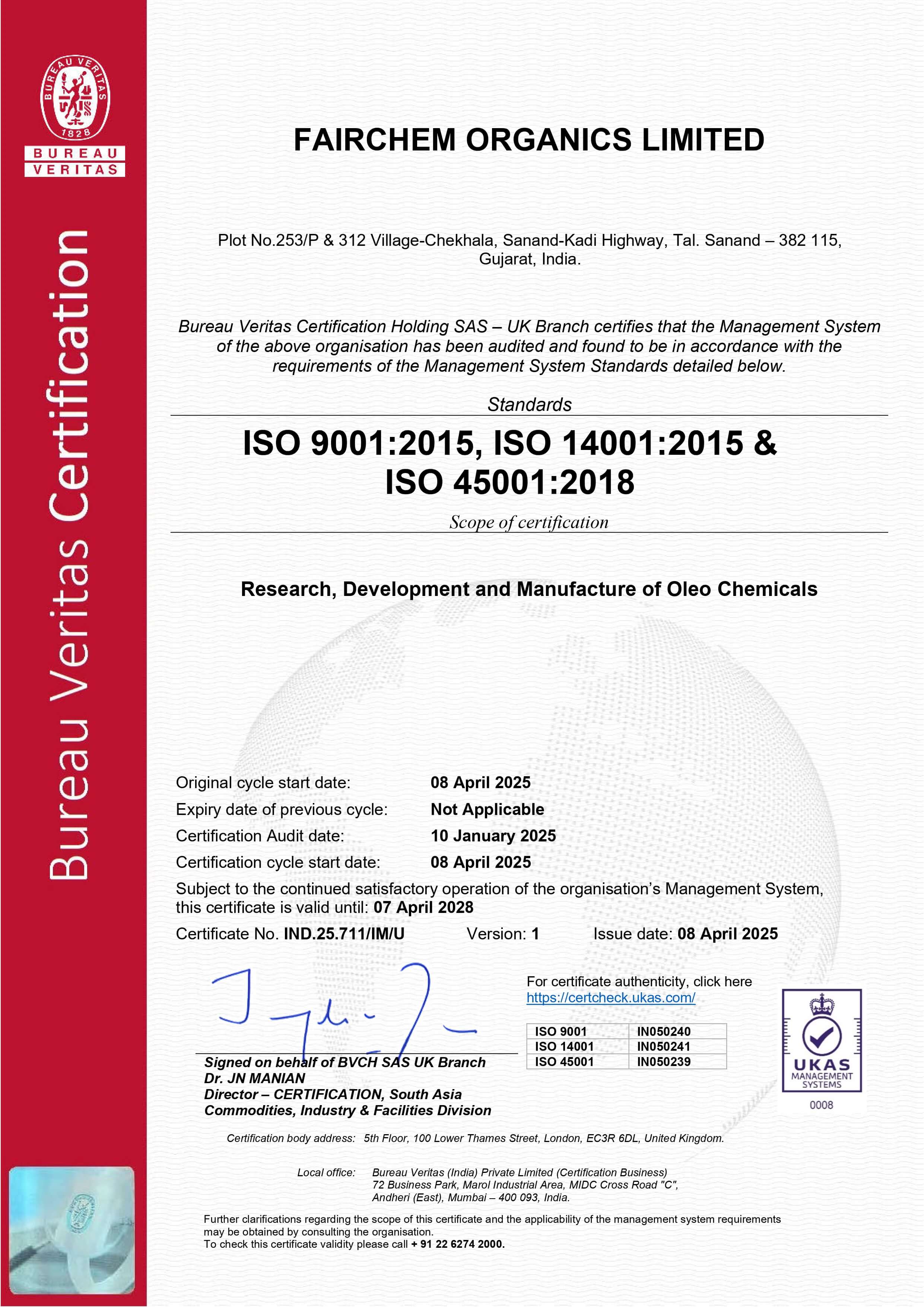
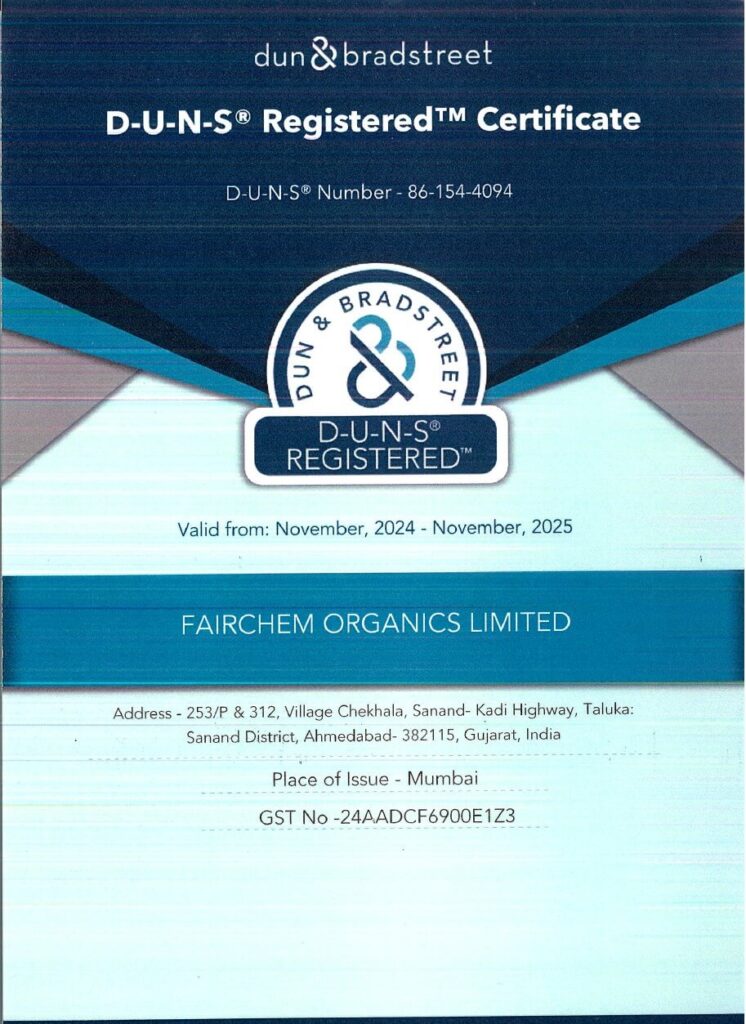
Fairchem holds certifications including REACH Compliance, HALAL, Kosher, DUNS, ISO 9001, ISO 14001, ISO 45001, and Bureau Veritas Certification. These collectively reflect the company’s commitment to quality management, environmental responsibility, occupational health and safety, and international regulatory compliance.
Among top specialty chemical companies in India operating in the oleochemical space, Fairchem is distinguished by its focus on specialty derivatives rather than commodity fatty acid volumes, its investment in process technology that produces branched-chain and dimerised products that require genuine technical capability, and its track record of supplying certified products to global markets across Asia, Europe, and the Americas.
See What Fairchem's Specialty Chemical Solutions Can Do for Your Business
Whether you are a personal care formulator, a coatings manufacturer, a printing ink producer, a lubricant supplier, or a nutraceutical company, the right specialty chemical raw material supplier makes a measurable difference to your product quality, supply consistency, and regulatory compliance.
Fairchem Organics Limited is ready to support your raw material requirements with a full range of certified specialty oleochemical products, backed by technical expertise and a production model built for consistent quality.
For sales enquiries: comm@fairchem.in
Call us: +91 2717-687900 / 687901 | +91 90163 24095
Get in touch today for product specifications, certifications, and pricing based on your application needs.
Frequently Asked Questions
Q1: What is the difference between specialty chemicals and commodity chemicals?
Commodity chemicals are produced in very large volumes and bought primarily on price. Specialty chemicals are selected for specific performance functions in a defined application. They are differentiated by formulation, purity, consistency, and the technical expertise of the supplier, rather than by volume or price alone.
Q2: Are oleochemical products considered specialty chemicals?
Yes, particularly specialty oleochemical derivatives like isostearic acid, dimer acid, and high-purity linoleic acid. These are produced through technically complex processes, serve specific industrial functions, and are valued by buyers for performance consistency. Basic soap-grade fatty acids sit closer to the commodity end of the spectrum.
Q3: Why are specialty chemical companies in India growing?
India’s growing domestic industrial base, improving manufacturing technology, alignment with international certification standards, and competitive production costs are all contributing to the growth of specialty chemical companies in India. Global buyers are also actively seeking alternatives to single-country sourcing, making Indian manufacturers attractive partners.
Q4: What certifications should a specialty chemical supplier hold?
For global supply, REACH compliance is important for European markets. HALAL and Kosher certifications are required for relevant product and geographic segments. ISO certifications reflect quality and environmental management systems. Bureau Veritas or equivalent third-party certification provides independent quality assurance to international buyers.