
Menu
What Are The Latest Trends in The Oleochemical Market?

The Oleochemical Market Is Changing Fast
A few years ago, bio-based chemicals were largely a niche segment discussed at sustainability conferences. Today, they are on the sourcing agenda of procurement heads at major companies across personal care, coatings, lubricants, food, and pharmaceuticals.
The oleochemical market sits right at the centre of this shift. Driven by a combination of tightening environmental regulations, rising raw material costs in petrochemicals, growing consumer preference for natural ingredients, and expanding manufacturing capability in countries like India, the global oleochemical industry is undergoing one of its most significant periods of change.
For businesses that buy, formulate, or manufacture using oleochemical inputs, keeping up with these trends is not optional. The way the market moves over the next few years will directly affect raw material availability, pricing, supplier selection, and formulation strategy.
This blog covers the key trends shaping the oleochemical market today, both in India and globally.
Trend 1: The Bio-Based Shift Is Now a Procurement Mandate
The move from petroleum-based chemicals to bio-based alternatives has been discussed for over a decade. What is different now is that it has moved from a voluntary sustainability initiative to a formal procurement requirement at major corporations globally.
European REACH regulations, US EPA guidelines, and India’s own green chemistry initiatives are putting pressure on supply chains to document and reduce the use of fossil-derived raw materials. In response, brands across personal care, paints, and adhesives are actively asking their oleochemical suppliers for bio-based content data, carbon footprint documentation, and third-party sustainability certifications.
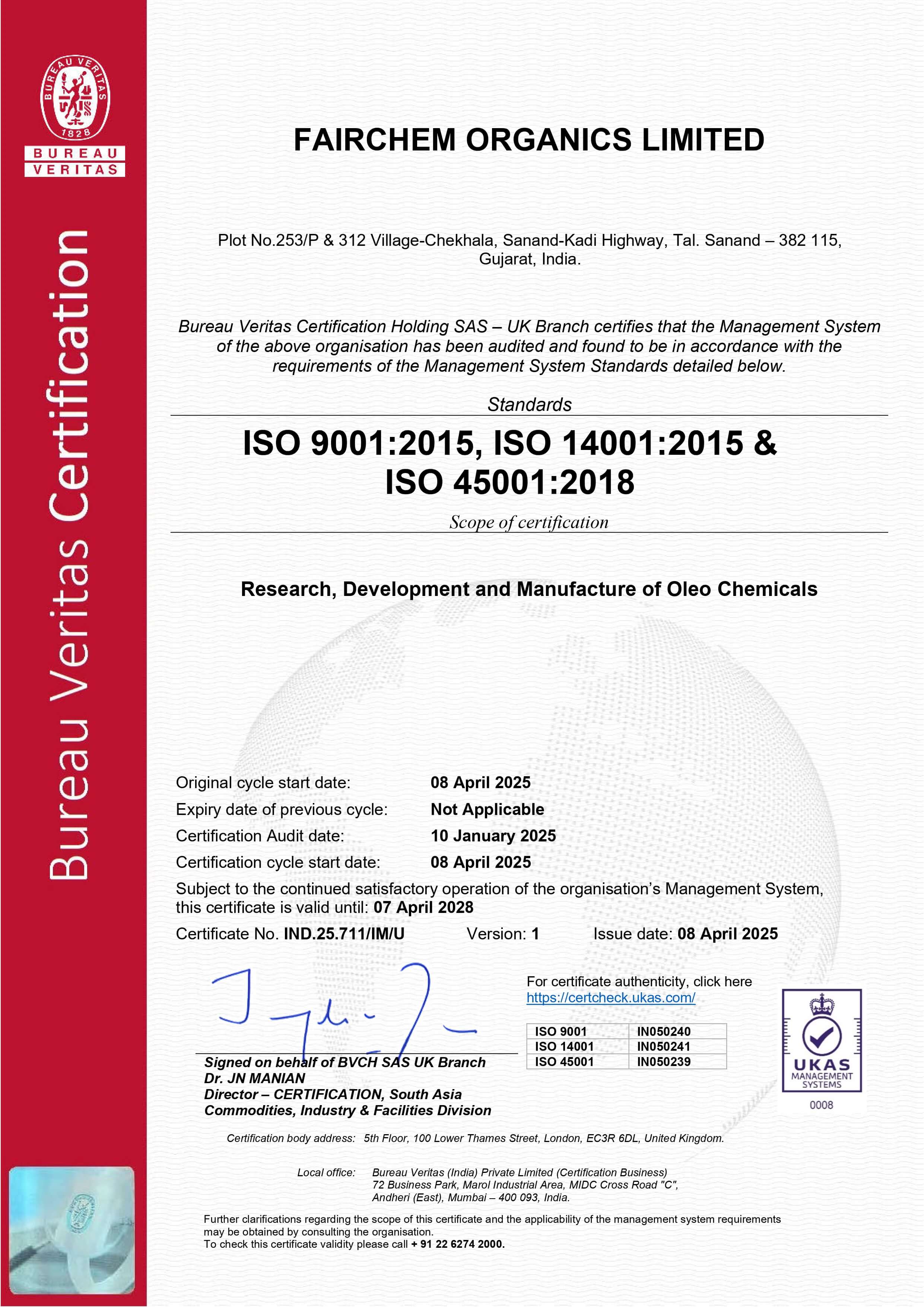
For the oleochemical industry, this is a significant opportunity. Fatty acids, dimer acid, distilled fatty acids, and other oleochemical derivatives are naturally bio-based, derived from renewable vegetable oil sources. Manufacturers who already hold REACH, HALAL, Kosher, and Bureau Veritas certifications are finding themselves better positioned than competitors who treated compliance as an afterthought.
Trend 2: Specialty Oleochemicals Are Growing Faster Than Commodities
The commodity end of the oleochemical market, primarily basic soap-grade fatty acids and glycerol, is mature and price-sensitive. The real growth is happening in specialty oleochemical products where performance, purity, and application-specific grades command significantly higher value.
Products like isostearic acid, dimer acid, linoleic acid, and high-purity distilled fatty acid fractions are seeing demand growth from multiple end-use sectors simultaneously. Cosmetic formulators want isostearic acid for its skin feel and oxidation stability. Coatings manufacturers want high-iodine linoleic acid for fast-drying formulations. Adhesive and polymer producers want consistent dimer acid grades for polyamide and epoxy systems.
Among distilled fatty acid manufacturers, those investing in fractionation technology to produce high-purity, narrow-cut specialty grades are growing faster than those producing broad-cut commodity blends. The market is clearly rewarding technical capability and product consistency over volume alone.
Trend 3: India Is Becoming a Global Oleochemical Supply Hub
For many years, Southeast Asia, particularly Malaysia and Indonesia, dominated global oleochemical supply due to their large palm oil feedstock base. That picture is changing.
India is emerging as a strong alternative supply source, particularly for oleochemicals derived from non-palm vegetable oils including soya, sunflower, rice bran, corn, and rapeseed. This matters because many global buyers, especially in Europe, are actively working to reduce their dependence on palm-derived ingredients due to deforestation concerns linked to palm cultivation.
Indian oleochemicals manufacturers using diverse, non-palm vegetable oil feedstocks are finding this a genuine market advantage. The ability to offer RSPO-free, palm-free oleochemical supply with strong certification credentials is opening doors in markets that were previously difficult to access.
India’s improving chemical manufacturing infrastructure, port connectivity, and growing pool of technically qualified producers are further strengthening this position. Gujarat in particular, with its concentration of chemical manufacturing clusters, has become one of the most active centres for oleochemical production and export in Asia.
Trend 4: Personal Care Remains the Fastest-Growing End Market
Among all the industries that use oleochemicals, personal care and cosmetics continues to show the strongest and most consistent demand growth. The global cosmetics market is expanding across all geographies, and the demand for naturally derived, skin-compatible ingredients is growing within it at an even faster rate.
Fatty acids and their derivatives form the backbone of most cosmetic formulations. Stearic acid, palmitic acid, isostearic acid, and linoleic acid are present in everything from daily moisturisers to premium anti-aging serums. For fatty acid suppliers serving the personal care sector, this sustained demand growth is providing a level of market stability that many other industries cannot match.
The trend within personal care is also moving toward cleaner labels and fewer synthetic ingredients, which further strengthens the case for oleochemical inputs that can be positioned as naturally derived and biodegradable.
Trend 5: Sustainability Certifications Are Now a Market Entry Requirement
Five years ago, certifications like REACH, HALAL, Kosher, and Bureau Veritas were valued additions that differentiated suppliers. Today, for many buyers, they are minimum entry requirements.
European importers require REACH documentation. Middle Eastern and Southeast Asian buyers require HALAL certification. Food and pharmaceutical manufacturers require Kosher certification. Global corporates sourcing from India require third-party quality audits.
Oleochemicals manufacturers who have invested in these certifications are seeing a clear commercial advantage. Those who have not are increasingly finding themselves excluded from tender processes and preferred supplier lists at major global brands.
This trend is only going to strengthen. As ESG reporting becomes mandatory for listed companies in India and globally, the demand for certified, traceable, and documented raw material supply chains will keep rising.
Trend 6: Green Lubricants and Industrial Bio-Based Products Are Opening New Markets
While personal care and soaps have historically been the largest end markets for oleochemicals, a growing area of demand is coming from industrial applications, specifically bio-based lubricants, metalworking fluids, and specialty coatings.
Isostearic acid and dimer acid are both finding growing use in high-performance lubricant formulations where bio-based content, thermal stability, and low-temperature performance are all required. As industries face pressure to reduce the environmental impact of their production processes, switching from petroleum-derived lubricant additives to oleochemical-derived alternatives is becoming a practical option rather than just an aspirational one.
This is expanding the total addressable market for oleochemical suppliers beyond their traditional customer base and creating new application opportunities that did not exist in meaningful volumes even five years ago.
Trend 7: Vertical Integration and Raw Material Security Are Becoming Priorities
The supply chain disruptions of recent years have pushed oleochemical buyers to think more carefully about where their raw materials come from and how secure that supply is. Single-source dependency, long lead times, and price volatility in feedstock markets have all contributed to a growing preference for suppliers with strong backward integration and direct access to vegetable oil raw materials.
For oleochemicals companies, this means that the ability to demonstrate raw material security, consistent production capacity, and multiple feedstock options is increasingly influencing buyer decisions beyond just price and specification matching.
Fairchem Organics Limited: Positioned for the Market Ahead
Fairchem Organics Limited has been manufacturing oleochemical products from its facility in Sanand, Ahmedabad since 1995. With a throughput capacity of 120,000 MTPA and a product portfolio covering Isostearic Acid, Stearic Acid, Palmitic Acid, Linoleic Acid, Dimer Acid, and Distilled Fatty Acids, the company is well placed to support the sourcing needs of industries responding to the trends described above.
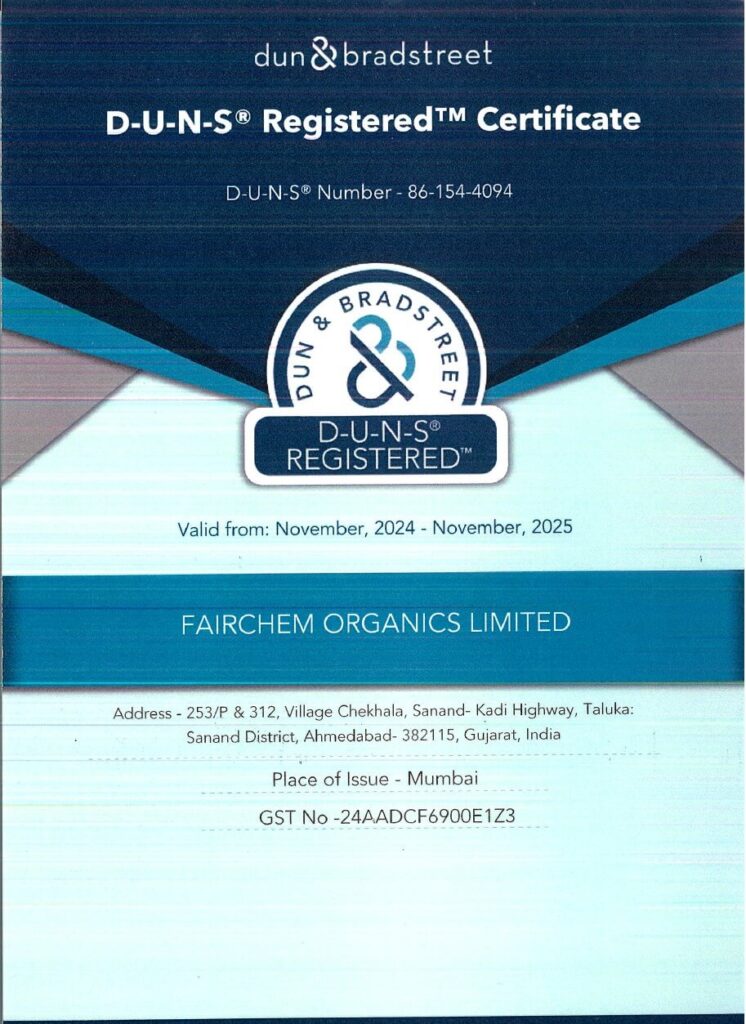
As an oleochemicals company with a non-palm vegetable oil feedstock base including soya, sunflower, corn, rice bran, and rapeseed, Fairchem offers a palm-free supply option that is increasingly valued by global buyers. Its certifications including REACH Compliance, HALAL, Kosher, DUNS, and Bureau Veritas position it as a qualified supplier for regulated markets in Asia, Europe, and the Americas.
For businesses planning their oleochemical sourcing strategy in the context of these market trends, Fairchem is a manufacturer worth having a conversation with.
Planning Your Oleochemical Sourcing Strategy?
The oleochemical market is moving in a clear direction, toward specialty products, bio-based supply chains, strong certifications, and suppliers with the technical capability to support application-specific requirements.
If your business is evaluating its raw material supply chain, adding a certified Indian manufacturer to your supplier list is a practical step worth taking now rather than later.
Fairchem Organics Limited is ready to support your requirements with a full range of certified oleochemical products, consistent quality, and technical expertise from its manufacturing base in Sanand, Ahmedabad.
For sales enquiries: comm@fairchem.in
Call us: +91 2717-687900 / 687901 | +91 90163 24095
Get in touch today for product specifications, certifications, and pricing based on your application needs.
Frequently Asked Questions
Q1: What is driving the growth of the oleochemical market globally?
The main drivers are the shift from petroleum-based to bio-based chemicals, growing demand from personal care and cosmetics, tightening environmental regulations, and increasing use of oleochemicals in industrial applications like lubricants and coatings.
Q2: Which oleochemical products are seeing the highest demand growth?
Specialty products including isostearic acid, dimer acid, and high-purity linoleic acid are growing faster than commodity fatty acid grades. Personal care and industrial lubricant applications are the primary drivers of this specialty segment growth.
Q3: Why are buyers reducing their dependence on palm-based oleochemicals?
European sustainability regulations and corporate ESG commitments are pushing buyers to source oleochemicals from non-palm feedstocks due to deforestation concerns associated with large-scale palm cultivation in Southeast Asia.
Q4: What certifications should an oleochemical supplier hold for global trade?
REACH compliance for European markets, HALAL and Kosher certifications for relevant regions, Bureau Veritas or equivalent third-party quality certification, and DUNS registration for international business credibility are the main certifications buyers look for.