
Menu
Isostearic Acid vs Stearic Acid: Differences for Formulators
Two Acids, Same Chain Length, Completely Different Behaviour
At first glance, isostearic acid and stearic acid look like close relatives. Both are eighteen-carbon fatty acids. Both are derived from vegetable oil processing streams. Both appear regularly on ingredient lists across personal care, industrial, and specialty chemical formulations.
But put them side by side in a formulation and the difference becomes immediately apparent. One is a white, waxy solid that requires melting before use. The other is a clear liquid at room temperature that blends effortlessly into most systems. One builds structure. The other delivers performance. Choosing between them is not a matter of preference. It is a matter of understanding exactly what your formulation needs.
This blog breaks down the key differences between isostearic acid and stearic acid for formulators across personal care, coatings, lubricants, and rubber industries, and explains when each one is the right choice for your application.
The Structural Difference That Changes Everything
The distinction between isostearic acid and stearic acid starts at the molecular level, and it is worth understanding because everything else follows from it.
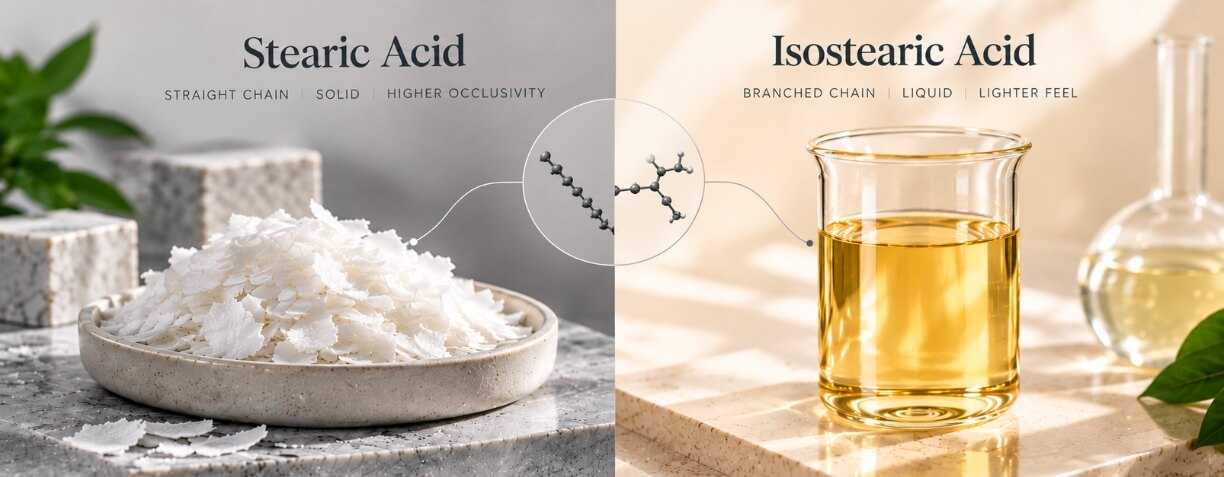
Stearic acid has a straight, linear carbon chain. Every carbon atom sits in sequence, one after the other, with no branching. This straight chain allows molecules to pack tightly against each other, which is why stearic acid is a solid, waxy material at room temperature. It has a defined melting point and needs to be heated before it can be incorporated into most liquid systems.
Isostearic acid has the same eighteen-carbon chain, but that chain branches at one point. This single structural difference prevents tight molecular packing, which keeps isostearic acid in liquid form at room temperature and across a wide range of processing conditions. It has a low pour point, remains pourable even at lower temperatures, and blends into formulation systems without any heating requirement.
This is the foundation of the isostearic acid stearic acid comparison. Same atom count, same carbon chain length, fundamentally different physical behaviour and application fit.
Performance Comparison Across Key Properties
Physical Form and Processing
Stearic acid is solid, supplied as flakes or pastilles, and requires melting before it can be added to most formulation systems. This adds a processing step and requires temperature-controlled equipment.
Isostearic acid is a clear, free-flowing liquid at ambient conditions, added directly without pre-melting. For formulators in Mumbai and Pune running continuous production lines, this difference has a practical impact on cycle time and energy cost.
Skin Feel and Sensory Profile
Stearic acid leaves a characteristic waxy feel on skin after application. At higher concentrations in leave-on products, this can translate to an occlusive or heavy sensory profile that many consumers find uncomfortable in modern skin care formulations.
Isostearic acid spreads with a smooth, non-greasy feel and does not leave a waxy residue. Its branched structure allows it to sit lightly on the skin surface, delivering moisturisation and conditioning without the heavy afterfeel. This sensory difference is one of the primary reasons personal care manufacturers in Ahmedabad and Surat working on premium skin and hair care product lines choose isostearic acid over stearic acid for their emollient base.
Oxidation Stability
Both are oxidation-stable. Stearic acid’s full saturation gives it long shelf life without antioxidant support. Isostearic acid, though derived from unsaturated precursors, is fully hydrogenated and equally resistant to oxidative degradation in finished formulations.
Low-Temperature Performance
Stearic acid solidifies at temperatures that cause handling problems in cold storage conditions or winter climates. Isostearic acid does not solidify under normal conditions, a clear advantage for formulators in Delhi and Surat managing products across India’s varied climate zones, from northern winters to Gujarat’s industrial heat.
Comedogenic Profile
Stearic acid carries a moderate comedogenic rating in cosmetic ingredient databases. At higher concentrations in face-applied products, it can contribute to pore-blocking for some skin types.
Isostearic acid has a significantly lower comedogenic rating, placing it in the low to very low category. This makes it a more suitable base emollient for formulations targeting oily, combination, or acne-prone skin where avoiding pore-clogging is a formulation requirement.
When to Choose Stearic Acid
Stearic acid is the right choice when your formulation needs:
Structure and hardness in bar soaps, balms, sticks, and wax-based systems. It is a proven thickener and structurant in solid formulation formats. Emulsification in cream and lotion systems where its role as an emulsifier, particularly as a soap in the presence of an alkali, is well established. Rubber vulcanisation activation, where stearic acid reacts with zinc oxide as a standard processing aid in rubber compounding used by manufacturers in Pune and Delhi. Plastic stabilisation and processing aid applications where its solid form and compatibility with polymer processing systems make it a standard input.
When to Choose Isostearic Acid
Isostearic acid is the right choice when your formulation needs:
A lightweight, non-greasy emollient in leave-on skin care and hair care products. Liquid-phase compatibility without melting steps in complex multi-component systems. Low comedogenic performance in face products targeting oily or sensitive skin types. Thermal stability and non-solidifying behaviour in lubricant and metalworking fluid applications. Broad ingredient compatibility with silicones, esters, waxes, conditioning polymers, and specialty actives.
For personal care and specialty oleochemical ingredient formulators in Ahmedabad and Mumbai working across multiple product categories, having both stearic acid and isostearic acid in the approved ingredient portfolio gives the formulation team maximum flexibility to match the base to the application requirement.
Sourcing Both from a Single Certified Supplier
One practical advantage that is often overlooked in the isostearic acid stearic comparison is that both products come from the same vegetable oil processing chain. Manufacturers who produce one also typically produce the other, which means consolidating supply through a single certified source is possible.
For procurement teams in Delhi, Pune, Mumbai, Ahmedabad, and Surat managing multiple raw material streams, working with an isostearic acid manufacturer in India that also produces stearic acid, palmitic acid, linoleic acid, and dimer acid simplifies vendor management, reduces logistics complexity, and creates a single point of quality accountability across the oleochemical ingredient portfolio.
Fairchem Organics Limited, based in Sanand, Ahmedabad, is one of the established acid manufacturers in India producing both isostearic acid and stearic acid alongside a full range of specialty oleochemicals from renewable vegetable oil by-product streams.
The company holds REACH Compliance, HALAL, Kosher, DUNS, ISO 9001, ISO 14001, ISO 45001, and Bureau Veritas certifications, supporting supply to regulated personal care, coatings, lubricants, and industrial markets both in India and internationally across Asia, Europe, and the Americas.
Need Isostearic Acid, Stearic Acid or Both for Your Formulation?
Whether you are a personal care formulator in Mumbai choosing between emollient bases, a procurement manager in Pune consolidating your oleochemical supplier list, a coatings chemist in Delhi evaluating specialty fatty acid inputs, or a manufacturing team in Ahmedabad or Surat managing multiple fatty acid raw material streams, Fairchem Organics Limited is ready to support your requirements.
Get in touch today with your product requirements and application details. Our team will come back with the right product specifications, grade recommendations, certifications, and pricing for both isostearic acid and stearic acid.
For sales enquiries: comm@fairchem.in
Call us: +91 2717-687900 / 687901 | +91 90163 24095
5 Trending FAQs on Isostearic Acid vs Stearic Acid
Q1: What is the main difference between isostearic acid and stearic acid?
Both are eighteen-carbon fatty acids but their molecular structures differ significantly. Stearic acid has a straight carbon chain and is a solid at room temperature. Isostearic acid has a branched carbon chain and is a clear liquid at room temperature. This structural difference changes their physical form, processing requirements, skin feel, melting behaviour, and comedogenic profile completely.
Q2: Which is better for skin care formulations, isostearic acid or stearic acid?
It depends on the product format and target skin type. Stearic acid is preferred in solid formats like bars and balms and in emulsifiers for standard cream systems. Isostearic acid is preferred in liquid leave-on formulations, premium serums, and products for oily or acne-prone skin where its lower comedogenic profile and non-greasy feel are important performance requirements.
Q3: Can isostearic acid replace stearic acid in an existing formulation?
Not directly without reformulation. They serve different functional roles. Stearic acid contributes structure and emulsification in ways that isostearic acid cannot because of its liquid form. In formulations where stearic acid is used primarily as an emollient rather than a structurant, isostearic acid can be evaluated as an alternative with sensory and comedogenic profile benefits.
Q4: Which fatty acid is better for rubber processing applications?
Stearic acid is the standard choice for rubber processing. It activates zinc oxide during vulcanisation, a reaction that isostearic acid’s branched structure does not support in the same way. Isostearic acid is not typically used in rubber compounding.
Q5: Where can formulators in India source both isostearic acid and stearic acid from a single certified supplier?
Established isostearic acid manufacturers in India, particularly those operating in Gujarat’s oleochemical manufacturing clusters, typically produce both products from the same vegetable oil processing chain. Buyers should look for suppliers holding REACH, HALAL, Kosher, and ISO certifications with batch-level documentation available for both products.