
Menu
What Is a Fatty Acid? Meaning, Types and Functions Explained
The Molecule Behind Your Food, Your Skin and Your Factory
Fatty acids are one of those things everyone has heard of and few can explain. They sit in the cooking oil in your kitchen, in the soap at your sink, in the cream on your shelf, and in the raw material lists of paint, rubber, and lubricant factories.
Understanding what a fatty acid is, and what it does, makes it easier to see why this single family of molecules supports so many industries. For students, formulators, and buyers in Mumbai, Ahmedabad, Delhi, Pune, and Surat, a clear grasp of the functions of fatty acids also helps when choosing the right grade for a specific job.
This guide covers the meaning, the main types, and the key functions of fatty acids, both in the body and in industry.
What Is a Fatty Acid? The Meaning
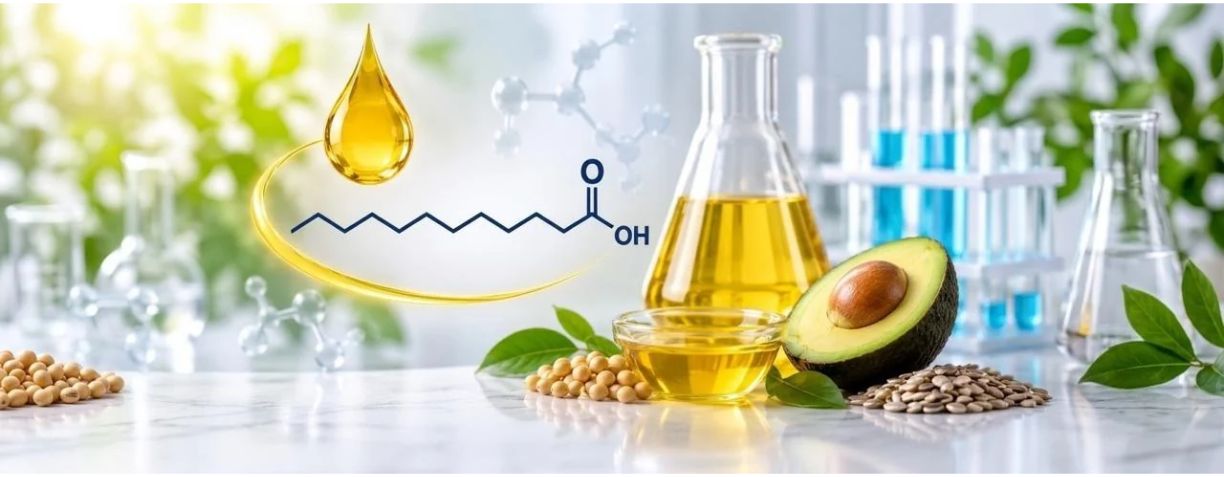
A fatty acid is an organic acid made of a chain of carbon atoms with hydrogen attached, ending in a carboxylic acid group. The chain is the fatty part. The acid group is the reactive end that lets the molecule bond with other chemicals.
In nature, fatty acids rarely float around alone. They are usually joined to glycerol to form fats and oils, known as triglycerides. When fats and oils are broken down, either by digestion in the body or by industrial fat splitting, individual fatty acids are released.
Those free fatty acids are the starting point of the oleochemical industry, which converts natural fats and oils into useful chemical products.
Types of Fatty Acids
Fatty acids are grouped by how their carbon chain is built.
Saturated Fatty Acids
Every carbon in the chain holds as much hydrogen as it can, so there are no double bonds. The chains are straight, pack tightly, and are usually solid at room temperature. Stearic acid and palmitic acid are the best-known examples. They are stable and resist oxidation.
Unsaturated Fatty Acids
These contain one or more double bonds, which put bends in the chain. They are mostly liquid at room temperature and more chemically reactive. Oleic acid has a single double bond and is called monounsaturated. Linoleic acid has more than one and is called polyunsaturated.
Branched-Chain Fatty Acids
Here the carbon chain splits off in a side branch. Isostearic acid is the main industrial example. The branching stops tight packing, so the acid stays liquid and remains stable. This makes it valuable in cosmetics and lubricants.
Classification by Chain Length
Fatty acids are also described as short, medium, or long chain. Long-chain types dominate industrial use because they provide the structure, lubricity, and film-forming behaviour that most formulations need.
Key Functions of Fatty Acids in the Body
The functions of fatty acids in living systems are broader than most people expect.
Energy storage and supply. Fatty acids are a dense energy source. The body stores surplus energy as fat and releases fatty acids when energy is needed.
Building cell membranes. Cell membranes are built largely from fatty acid-based lipids. Their makeup affects how flexible and functional the membrane is.
Supporting the brain and nervous system. Certain polyunsaturated fatty acids are key structural components of nerve and brain tissue.
Producing signalling molecules. The body converts some fatty acids into compounds that help regulate inflammation, blood pressure, and immune response.
Absorbing fat-soluble vitamins. Vitamins A, D, E, and K need dietary fat to be absorbed properly.
Maintaining skin health. Fatty acids help form the skin’s protective barrier, which holds in moisture.
Some of these, called essential fatty acids, cannot be made by the body and must come from food
Functions of Fatty Acids in Industry
Outside the body, fatty acids work as raw materials and functional ingredients across sectors.
Soaps and detergents. Fatty acids react with alkali to form soaps, which clean by lifting oil and dirt. Stearic and palmitic acids shape hardness and lather.
Personal care. They act as emollients, thickeners, emulsifiers, and conditioning agents in creams, lotions, and hair products. Branched types give light, non-greasy skin feel.
Paints, coatings, and inks. Unsaturated fatty acids dry and form durable films. Dimer acid, made by joining two fatty acid molecules, acts as a curing agent and resin building block.
Rubber and plastics. Stearic acid activates vulcanisation in rubber and acts as a lubricant and stabiliser in plastic processing.
Lubricants and metalworking. Fatty acids and their derivatives form protective films on metal surfaces and reduce friction.
Pharmaceuticals and nutrition. They serve as excipients, tablet lubricants, and nutritional ingredients.
Manufacturers in Pune and Surat, for example, use different fatty acid grades across rubber, coatings, and textile processing, while personal care and packaging companies in Mumbai and Delhi depend on them for formulations and inks.
Why Fatty Acid Quality Matters
Because fatty acids enter formulations at the base level, small differences in purity, colour, or composition travel straight into the finished product. A soap that discolours, a cream that separates, or a paint that dries slowly can often be traced back to the raw material.
This is why buyers look closely at fatty acid manufacturers that run controlled processes, test every batch, and document results. Consistency from batch to batch is as valuable as the headline specification.
Choosing Fatty Acid Suppliers in India
India has a strong base of vegetable oil refining, which supports a growing oleochemical sector. When evaluating fatty acid suppliers in India, buyers should check:
Certifications. REACH compliance, HALAL, Kosher, ISO, and third-party audits show an audited quality system.
Batch documentation. Certificates of analysis for every shipment support your own quality records.
Product range. A supplier covering several fatty acids allows consolidated purchasing.
Technical support. Application knowledge helps match grade to use.
Feedstock traceability. Documented raw material origin supports sustainability reporting.
Fairchem Organics Limited: Fatty Acids From Vegetable Oil Streams
Fairchem Organics Limited, based in Sanand, Ahmedabad, is among the established fatty acid manufacturers in India. It converts vegetable oil by-product streams, including soya, sunflower, corn, rice bran, and rapeseed, into specialty oleochemicals.
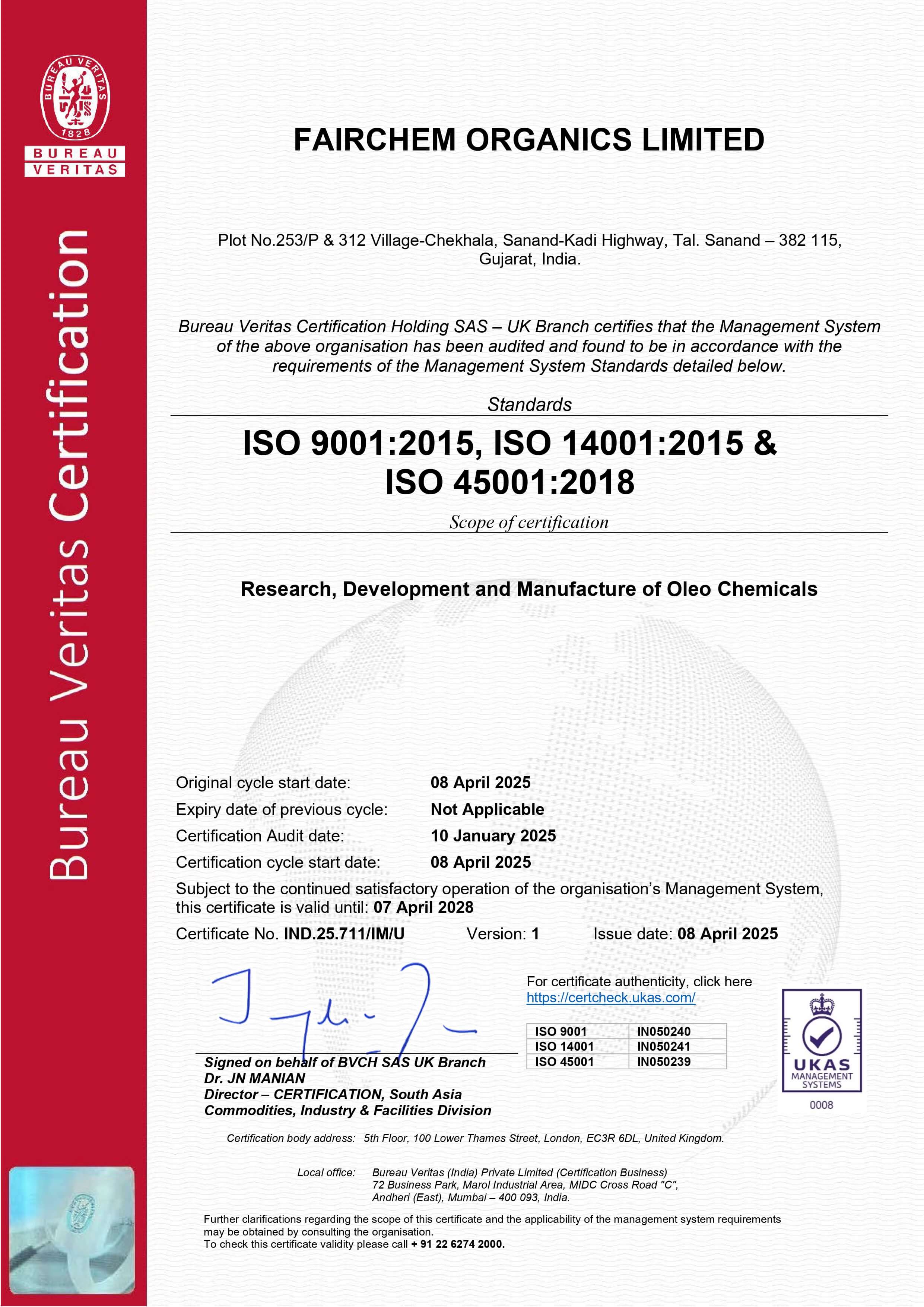
The range includes Isostearic Acid, Dimer Acid, Linoleic Acid, Stearic Acid, Palmitic Acid, and Distilled Fatty Acids, supplied to industries across India, Asia, Europe, and the Americas. Fairchem holds REACH Compliance, HALAL, Kosher, DUNS, ISO, and Bureau Veritas certifications, supporting supply to regulated sectors.
Need Fatty Acids for Your Formulation or Production Line?
Whether you make soaps in Surat, coatings in Pune, personal care products in Mumbai or Delhi, or manage procurement in Ahmedabad, the right fatty acid grade improves consistency and performance.
Fairchem Organics Limited is ready to support your requirements with certified oleochemicals and dependable supply. Send us your application and volume details, and our team will respond with suitable grades, documentation, and pricing.
For sales enquiries: comm@fairchem.in
Call us: +91 2717-687900 / 687901 | +91 90163 24095
5 Trending FAQs on Fatty Acids
Q1: What is a fatty acid in simple words?
A fatty acid is a chain of carbon atoms ending in an acid group. It is the building block of fats and oils and is released when they are broken down.
Q2: What are the main types of fatty acids?
The main types are saturated, unsaturated, and branched-chain fatty acids. They differ in how the carbon chain is built, which changes their physical form and behaviour.
Q3: What are the main functions of fatty acids in the body?
They supply energy, build cell membranes, support brain and nerve tissue, produce signalling molecules, help absorb fat-soluble vitamins, and maintain the skin barrier.
Q4: How are fatty acids used in industry?
They are used in soaps, personal care products, paints, inks, rubber, plastics, lubricants, and pharmaceuticals, depending on the type and grade.
Q5: How do I choose a fatty acid supplier?
Check certifications, batch documentation, product range, technical support, and consistency across several recent batches.