
Menu
Dimer Acid Manufacturers in India: How to Choose the Right Supplier for Paints, Inks and Adhesives
The Supplier You Choose Decides the Product You Get
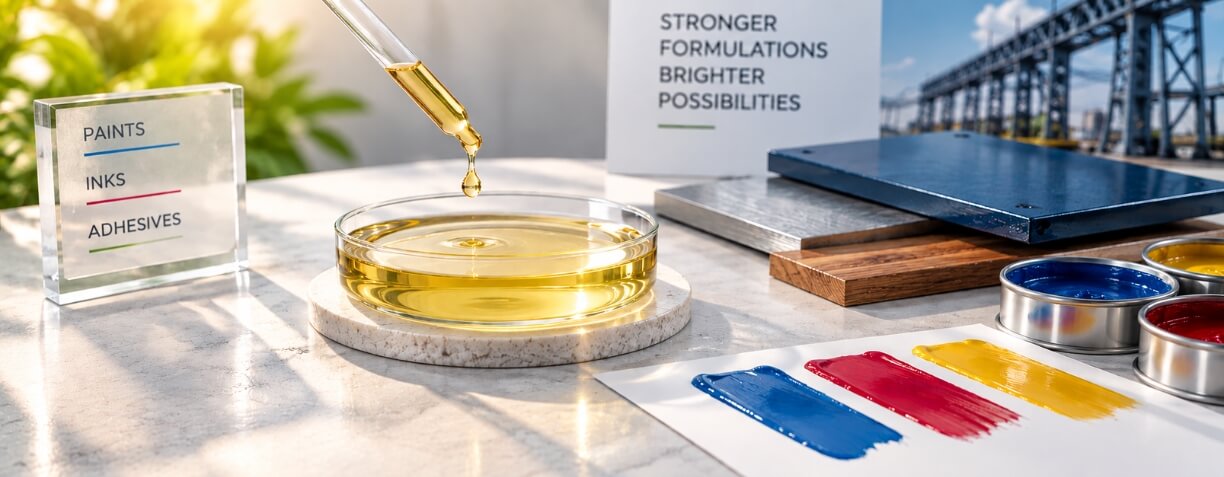
Dimer acid is not a raw material you can source casually. It sits inside epoxy coatings that protect steel structures from corrosion, printing inks that run through high-speed packaging presses, and structural adhesives that hold assemblies under mechanical stress. If the dimer acid entering your facility is inconsistent or off-specification, the problem does not stay at goods-in. It moves into your finished product, your customer complaints, and your quality rejections.
The dimer acid market in India has grown considerably, and with it, the variation in supplier quality. For procurement and formulation teams at paints, inks, and adhesives companies in Mumbai, Pune, Ahmedabad, and Vadodara, knowing how to evaluate a supplier properly has become a skill that directly affects production outcomes.
This blog covers what dimer acid is, which applications depend on it, and what criteria should drive your supplier selection.
What Is Dimer Acid and Why Is It a Specialty Product
Dimer acid, also called dimeric acid, is produced by joining two molecules of unsaturated fatty acids through a controlled dimerisation reaction. The starting material is typically an unsaturated fatty acid sourced from vegetable oil streams. Under controlled heat and pressure in an industrial reactor, two fatty acid molecules bond together to form a larger dicarboxylic acid molecule.
This dicarboxylic structure, with two acid groups at either end of a large, flexible carbon chain, is what makes dimer acid so different from standard fatty acids. It can react at both ends, which makes it a functional building block for polymer chemistry in a way that single-acid fatty acids cannot match.
The production of dimer acid is technically demanding. It requires precise dimerisation conditions, controlled separation technology to separate the dimer fraction from lighter monomer and heavier trimer by-products, and careful distillation to achieve the required purity. This technical barrier is why not every oleochemicals manufacturer in India produces dimer acid, and why the quality gap between producers is more pronounced here than in commodity fatty acid categories.
Where Dimer Acid Is Used and Why Quality Is Non-Negotiable
Paints and Anti-Corrosion Coatings
In epoxy-based protective coatings, dimer acid functions as a curing agent. When combined with epoxy resins, it produces a coating film that is flexible, strongly adhesive, and resistant to corrosion, moisture, and chemical attack.
The flexibility that dimer acid introduces is the key differentiator. Standard amine-cured epoxy coatings can be rigid and prone to cracking under mechanical stress or thermal cycling. Dimer acid-cured systems flex rather than crack, extending the service life of the coating. For coatings manufacturers in Ahmedabad and Vadodara supplying infrastructure, marine, and industrial markets, this property combination is not optional, it is the specification requirement.
If the dimer acid input has an inconsistent acid value or higher-than-specified colour, it directly affects the curing behaviour and the final appearance of the coating. These are failures that show up on the customer’s end, not at your incoming quality check.
Printing Inks
Polyamide resins produced from dimer acid are used as binders in flexographic and gravure inks for flexible packaging. These inks need to adhere to plastic films and foils, release solvent quickly on high-speed presses, and resist moisture and abrasion in the finished packaged product.
The quality of the dimer acid directly determines the polyamide resin’s viscosity, adhesion strength, and press performance. Printing ink manufacturers in Mumbai and Pune supplying food and FMCG packaging sectors work to tight specifications, and raw material variability is one of the primary causes of press-room problems.
Adhesives and Sealants
In hot-melt and structural adhesive systems, dimer acid-derived polyamides provide flexibility, broad substrate adhesion, and peel resistance. The automotive, footwear, bookbinding, and woodworking sectors across India are active users, and domestic demand for quality dimer chemicals is expanding in line with manufacturing growth in these segments.
What to Check When Evaluating Dimer Acid Manufacturers in India
Not all dimer acid manufacturers in India are operating at the same level of process capability or quality assurance. Here is what to verify before finalising a supplier:
Product specification consistency. Ask for certificates of analysis from multiple recent batches and compare the acid value, colour grade, dimer content, and trimer content across them. Narrow batch-to-batch variation is the mark of a well-controlled production process. Wide variation is a red flag.
Dimer content and trimer levels. Higher dimer content and lower trimer content generally indicate a more refined, higher-quality product. Trimer-rich dimer acid can cause viscosity issues in polyamide resin synthesis and adhesive formulations.
Colour grade. For printing ink and coating applications where product colour matters, the Gardner colour grade of the dimer acid input is a critical parameter. Suppliers who cannot consistently deliver low-colour product are not suitable for these applications.
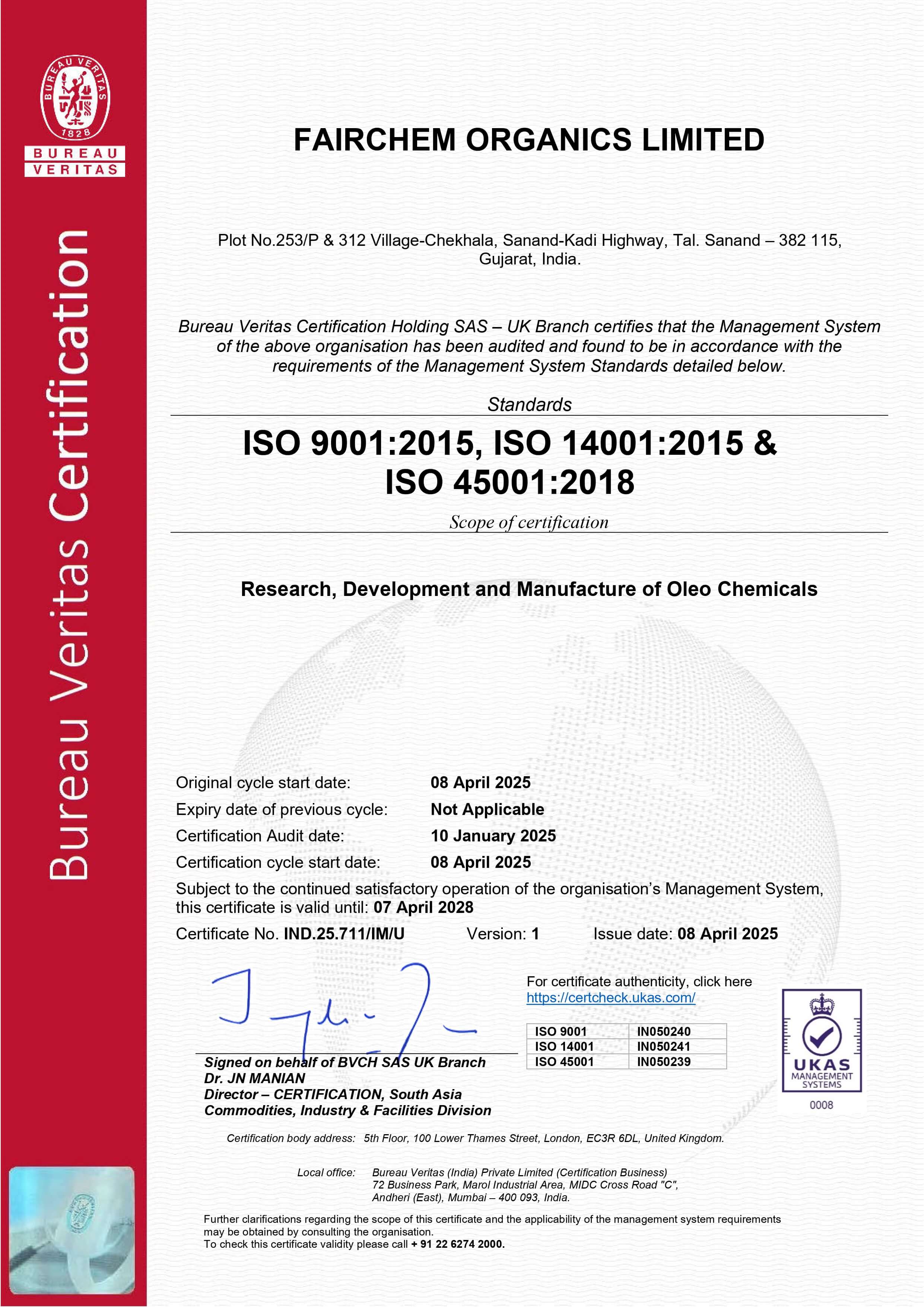
International certifications. REACH compliance is important if your finished products enter European markets. ISO quality system certification demonstrates that the supplier’s production and testing processes are documented and audited. Bureau Veritas or equivalent third-party certification provides independent verification.
Feedstock transparency. The vegetable oil source affects the fatty acid profile of the dimer acid. Suppliers who document their feedstock origin give buyers the traceability needed for sustainability reporting and export compliance.
Technical support. A capable supplier should be able to discuss your application, recommend the appropriate grade, and support troubleshooting. Suppliers who can only discuss price are not genuine specialty chemical partners.
The Dimer Acid Market in India: Current Direction
The dimer acid market in India is being shaped by steady domestic demand from paints, inks, and adhesive sectors, alongside growing export interest from European buyers who prefer non-palm, vegetable oil-derived dimer acid over Southeast Asian alternatives. End-use industries are also tightening incoming quality standards, particularly for coatings used in food contact packaging, construction, and automotive applications. This is progressively narrowing the field of viable suppliers for serious industrial buyers.
Fairchem Organics Limited: A Certified Dimer Acid Manufacturer in India
Fairchem Organics Limited, based in Sanand, Ahmedabad, is among the established dimer acid manufacturers in India, producing high-quality dimer acid from vegetable oil by-product streams including soya, sunflower, corn, rice bran, and rapeseed.
As part of a broader oleochemicals manufacturers portfolio that also includes Isostearic Acid, Stearic Acid, Palmitic Acid, Linoleic Acid, and Distilled Fatty Acids, Fairchem offers buyers the advantage of sourcing multiple specialty oleochemical inputs from a single certified, experienced producer.
The company holds REACH Compliance, HALAL, Kosher, DUNS, ISO 9001, ISO 14001, ISO 45001, and Bureau Veritas certifications. These credentials support supply to regulated industries across Asia, Europe, and the Americas with the documentation and traceability that international buyers require.
For procurement teams in Mumbai, Vadodara, Pune, and Ahmedabad evaluating dimer acid supply for coatings, inks, or adhesive applications, Fairchem provides both the product specification and the certification framework that serious industrial buyers need from a long-term supply partner.
Do Not Let Raw Material Quality Be the Weak Link in Your Formulation
Your coatings, inks, and adhesives are only as good as the dimer acid that goes into them. Working with a certified, experienced, and technically capable supplier is the most effective way to protect your formulation performance and your production consistency.
Fairchem Organics Limited is ready to support your dimer acid requirements with consistent product quality, full certification documentation, and technical expertise from its manufacturing base in Sanand, Ahmedabad.
For sales enquiries: comm@fairchem.in
Call us: +91 2717-687900 / 687901 | +91 90163 24095
5 Trending FAQs on Dimer Acid and Supplier Selection
Q1: What is the difference between dimer acid and standard fatty acids?
Standard fatty acids are single-chain organic acids produced through fat splitting of vegetable oils. Dimer acid, or dimeric acid, is produced by chemically joining two unsaturated fatty acid molecules together, creating a larger dicarboxylic molecule. This dual-acid structure gives it unique reactivity as a polymer building block that single-chain fatty acids cannot replicate.
Q2: What dimer acid specification parameters matter most for epoxy coating applications?
For epoxy curing applications, the most important parameters are acid value (which determines reactivity with the epoxy), dimer content (higher is better for film flexibility), trimer content (lower is preferred), and colour grade (important for light-coloured coating systems). Batch-to-batch consistency across all these parameters is as important as the specification itself.
Q3: Why are Indian buyers reducing imports and sourcing dimer acid domestically?
The growth of capable domestic producers with international certifications, combined with competitive pricing and shorter lead times, has made domestic sourcing increasingly attractive. The ability to receive consistent supply with local technical support and documentation aligned to Indian regulatory requirements adds further practical advantages over imported material.
Q4: How does dimer acid feedstock origin affect product quality?
The fatty acid composition of the feedstock, determined by whether it comes from soya, sunflower, rapeseed, or other vegetable oil streams, affects the dimer acid’s colour, dimer-to-trimer ratio, and reactivity profile. Suppliers who use well-characterised, consistent feedstock sources tend to produce more consistent dimer acid product than those sourcing mixed or uncharacterised oil streams.
Q5: Is bio-based dimer acid accepted in European export markets?
Yes. Bio-based dimer acid from non-palm vegetable oil sources with REACH compliance documentation is actively preferred by European buyers, particularly those with sustainability commitments that require them to document bio-based content and avoid palm-derived chemical inputs. Indian producers using soya or sunflower feedstocks are well-positioned for this market preference.