
Menu
Oleochemicals Manufacturing Explained: Fairchem Process, Quality and Applications
Manufacturing That Starts Where Others Stop
Most manufacturing businesses buy refined, ready-to-use raw materials and convert them into finished goods. Fairchem Organics Limited works differently. It starts at an earlier point in the supply chain, one that most companies ignore entirely.
When vegetable oil refineries process soya, sunflower, corn, rice bran, or rapeseed into cooking oil, they generate a range of fatty acid-rich by-product streams. These streams are often treated as waste or sold at low value. Fairchem procures these streams, processes them through advanced separation and purification technology, and converts them into high-value specialty oleochemicals used across industries in India and globally.
This model is efficient, cost-competitive, and genuinely sustainable. It creates value from material that would otherwise be discarded. And it is the foundation on which Fairchem has built its position as one of the recognised oleochemicals manufacturers in India today.
What the Oleochemical Manufacturing Process Actually Involves
Understanding how oleochemicals are made helps explain why quality varies so significantly across suppliers and why process capability is one of the most important factors when evaluating an oleochemicals company in India.
The manufacturing process at a modern oleochemical facility typically follows a sequence of distinct stages:
Raw material intake and assessment. Incoming vegetable oil by-product streams are tested and assessed for fatty acid composition, quality, and consistency before entering the production process. The quality of incoming raw material directly affects the quality of the finished product, which is why sourcing discipline matters as much as processing technology.
Fat splitting or hydrolysis. The raw oil streams are processed under high pressure and temperature with steam to break the triglyceride structure down into free fatty acids and glycerol. This is the starting point for most oleochemical product lines.
Fractionation and distillation. The crude fatty acid mixture is then processed through distillation columns that separate specific fatty acid fractions by chain length, boiling point, and degree of saturation. This is where individual products like stearic acid, palmitic acid, linoleic acid, and distilled fatty acid blends are isolated to specification.
Dimerisation. Unsaturated fatty acids from the distillation process are directed into a dimerisation reactor where, under controlled heat and pressure, two fatty acid molecules bond together to form dimer acid. The lighter fractions from this process go on to be isomerised and hydrogenated to produce isostearic acid.
Hydrogenation and isomerisation. The lighter branched fractions from dimerisation are processed through hydrogenation to stabilise the molecule and isomerisation to create the branched-chain structure that gives isostearic acid its liquid form and performance properties.
Refining, testing, and packaging. Every finished product goes through quality control testing before being approved for despatch. Acid value, iodine value, colour grade, moisture content, and other parameters are checked against specification before the product leaves the facility.
This process chain is why oleochemicals manufacturers who invest in the full range of processing technology can offer a broader and higher-value product portfolio than those operating with only basic fat-splitting and distillation capability.
Fairchem's Product Range and What Each Product Does
Fairchem’s manufacturing process produces a full range of specialty oleochemical products. Here is what each one is used for and which industries in India and globally depend on them:
Isostearic Acid is a branched-chain fatty acid that stays liquid at low temperatures and delivers a non-greasy, smooth feel on skin. It is used in lipsticks, foundations, sunscreens, hair conditioners, high-performance lubricants, and specialty coatings. Personal care manufacturers in Pune and Chennai are among the consistent users of cosmetic-grade isostearic acid in India.
Dimer Acid is used as a curing agent in epoxy anti-corrosion coatings, as a binder in polyamide-based printing inks, as a stabiliser in cold rolling mill lubricants, and as a building block in structural adhesives. Coatings and adhesive producers in Gurugram, Noida, and Surat’s industrial clusters regularly source dimer acid for high-performance formulations.
Linoleic Acid is a fast-drying polyunsaturated fatty acid used in paints, printing inks, and sealant formulations where oxidative drying is a performance requirement. Paint manufacturers across India, including those in Chennai and Pune, use it as a functional ingredient in alkyd-based coating systems.
Stearic Acid is used in rubber processing, soap manufacturing, plastic stabilisation, cosmetics, and pharmaceuticals. It is one of the most widely consumed oleochemical inputs across Indian industry.
Palmitic Acid is used in soaps, detergents, candles, food processing, and cosmetics. Manufacturers in Surat and Noida working in textile auxiliary and soap production are among its users in the domestic market.
Distilled Fatty Acids are refined fatty acid blends serving soaps, detergents, textile auxiliaries, industrial lubricants, and surface treatment industries. They are the volume workhorse of Fairchem’s product portfolio.
Quality: Where the Difference Between Suppliers Becomes Visible
In the oleochemical industry, the gap between a well-produced batch and a poorly produced one is not always visible on the specification sheet. It shows up in the performance of the finished product.
An inconsistent acid value can destabilise an emulsion in a cosmetic cream. A higher-than-specified colour grade in a distilled fatty acid can discolour a soap bar. Variability in iodine value in linoleic acid can change the drying speed of a paint formulation. These are real production problems that formulators and quality teams deal with when their raw material supply is not consistent.
This is why Fairchem’s quality system is built around process discipline, not just end-point testing. Incoming raw materials are assessed before processing, in-process parameters are monitored at each stage, and finished products are tested against specification before despatch. Every batch is accompanied by a certificate of analysis that documents the key quality parameters the buyer needs for their own formulation records.
Certifications That Support Global and Regulated Markets
Fairchem holds a set of certifications that reflect both its quality management standards and its eligibility to supply regulated industries globally.
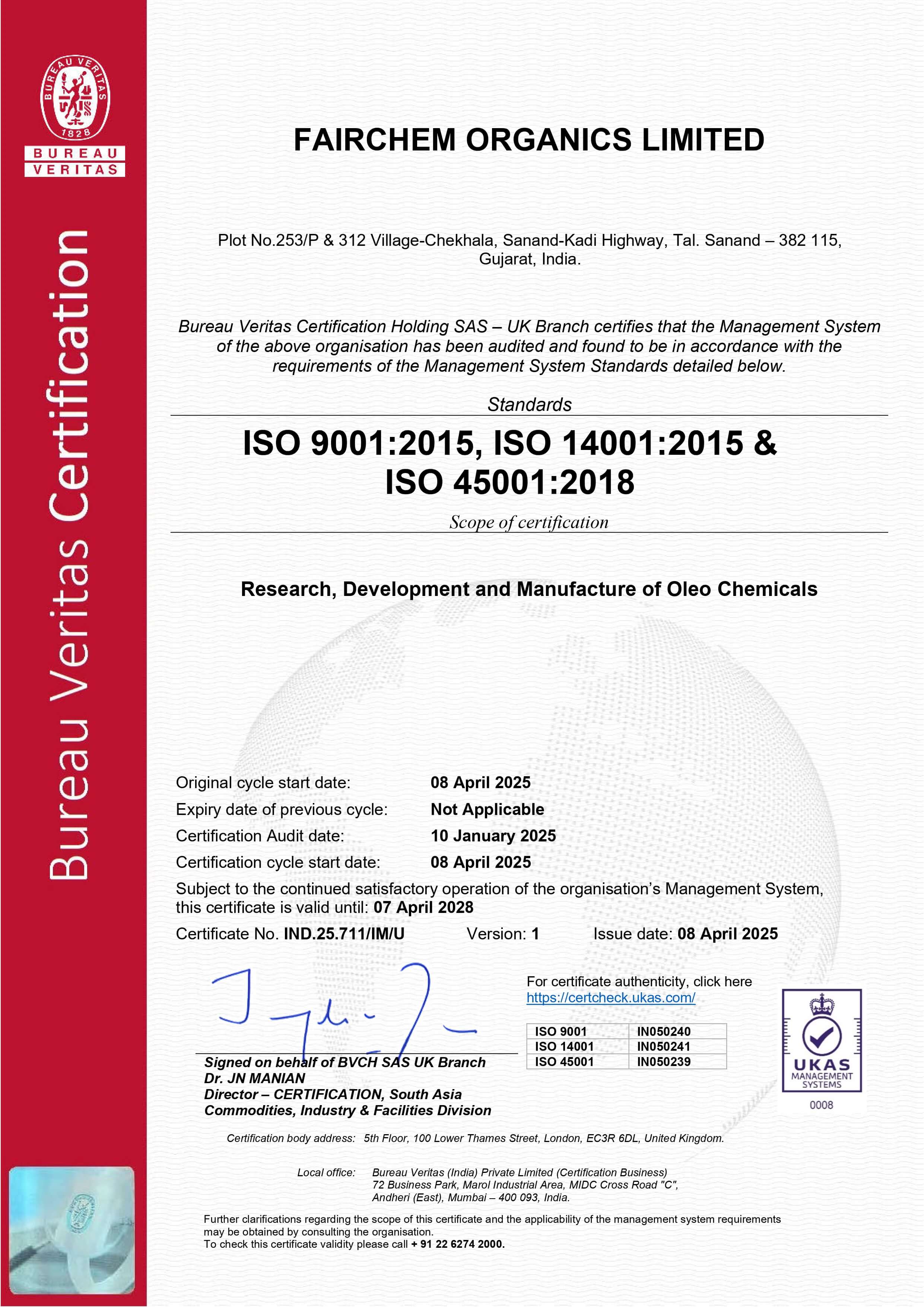
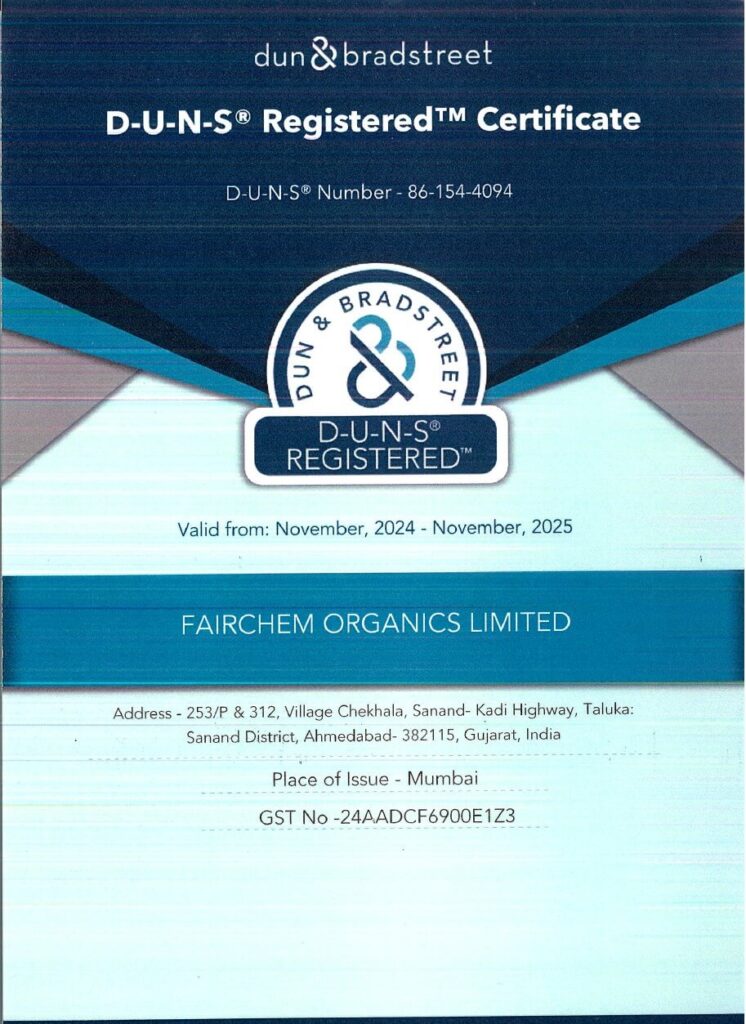
ISO 9001 certification covers its quality management system. ISO 14001 covers environmental management, and ISO 45001 covers occupational health and safety. REACH compliance enables supply to European markets under the EU’s chemical safety framework. HALAL and Kosher certifications support supply to relevant geographic and product segments. DUNS registration provides international business credibility, and Bureau Veritas certification provides independent third-party quality assurance to global buyers.
For procurement teams in Noida, Gurugram, Chennai, Surat, and Pune evaluating domestic sources for regulated applications, these certifications are important validation that the supplier operates to documented and audited standards rather than just stated ones.
Why Fairchem Stands Out Among Oleochemicals Companies in India
There are a growing number of oleochemicals companies in India. What sets Fairchem apart is a combination of factors that individually matter and together create a meaningful supply advantage.
Its raw material model, sourcing from vegetable oil refinery by-product streams, gives it a sustainable and cost-efficient starting point that also aligns with the bio-based sourcing preferences of global buyers. Its process capability, spanning fat splitting through fractionation, dimerisation, hydrogenation, and isomerisation, allows it to produce both commodity and specialty oleochemicals from a single integrated facility. Its certification portfolio supports supply to regulated markets across Asia, Europe, and the Americas without requiring buyers to work through additional documentation processes.
And its track record, built over three decades of consistent manufacturing and supply, is something that newer entrants in the oleochemical industry simply cannot match.
Get in Touch with Fairchem Organics Limited
Whether you are a formulator in Chennai assessing a new emollient source, a procurement manager in Gurugram evaluating dimer acid supply, a coatings producer in Noida evaluating consistent linoleic acid grades, or a personal care manufacturer in Pune building out your raw material supply chain, Fairchem Organics Limited is ready to support your requirements.
For sales enquiries: comm@fairchem.in
Call us: +91 2717-687900 / 687901 | +91 90163 24095
5 Trending FAQs on Oleochemicals Manufacturing
Q1: What is the main raw material used in oleochemicals manufacturing in India?
Indian oleochemical manufacturers primarily use vegetable oil by-product streams from the refining of soya, sunflower, rice bran, corn, and rapeseed. These streams are rich in fatty acids and form the feedstock for a wide range of oleochemical products. India’s non-palm feedstock base is a growing advantage with global buyers who are reducing dependence on palm-derived ingredients.
Q2: How is dimer acid different from standard fatty acids produced in the same facility?
Standard fatty acids like stearic and palmitic acid are produced through fat splitting and fractionation. Dimer acid requires an additional dimerisation step where two unsaturated fatty acid molecules are joined together under heat and pressure. This extra processing stage makes it a higher-value specialty product with performance properties that standard fatty acids cannot match in coatings, adhesive, and polymer applications.
Q3: Why does oleochemical product quality vary so much across suppliers?
Quality variation comes from differences in raw material sourcing discipline, process technology investment, and in-process quality control. Suppliers with limited processing infrastructure may produce wider-specification products with more batch-to-batch variability. Manufacturers with integrated, multi-stage processing and documented quality systems produce tighter specifications and more consistent batches.
Q4: What certifications should an oleochemicals company in India hold for export markets?
REACH compliance is important for European buyers. HALAL and Kosher certifications are required for relevant geographic and product segments. ISO 9001 documents the quality management system. Bureau Veritas or equivalent third-party certification provides independent quality assurance. DUNS registration supports international business verification. Together these certifications signal that the supplier operates to auditable international standards.
Q5: How are oleochemicals different from synthetic chemicals used in the same applications?
Oleochemicals are derived from renewable biological sources, principally vegetable oils. Synthetic alternatives are typically derived from petroleum. Oleochemicals are biodegradable, have a lower carbon footprint over their lifecycle, and are increasingly preferred by industries that need to document sustainable sourcing. In many applications, particularly personal care and coatings, oleochemicals also offer performance advantages over their synthetic counterparts.