
Menu
Oleochemical Ingredients for Personal Care & Cosmetics
What Is Actually Inside Your Skincare Product?
Turn over your favourite moisturiser, lipstick, or hair conditioner and read the ingredient list. You will find names like stearic acid, isostearic acid, palmitic acid, and various fatty acid esters. These are not synthetic chemicals cooked up in a petroleum refinery. They come from nature, from vegetable oils like soybean, sunflower, rice bran, and rapeseed, processed through industrial oleochemistry into high-performance cosmetic ingredients.
The personal care and cosmetics industry is one of the largest consumers of oleochemical ingredients globally. In India, this connection between the oleochemical industry and beauty and personal care manufacturing has grown significantly over the past decade, driven by rising consumer demand for naturally derived, sustainable, and skin-compatible formulation inputs.
If you formulate personal care products, procure raw materials for a cosmetics brand, or simply want to understand what goes into the products you use every day, this guide covers the key oleochemical ingredients used in personal care and cosmetics, what each one does, and why sourcing quality matters more than most formulators initially realise.
Why the Personal Care Industry Prefers Oleochemical Ingredients
Before getting into specific ingredients, it is worth understanding why oleochemicals have become the preferred raw material for cosmetic formulators globally.
First, they are bio-based and renewable. As sustainability becomes a procurement priority for global beauty brands, ingredients derived from vegetable oils offer a credible bio-based story backed by third-party certifications.
Second, their skin compatibility is exceptional. Because oleochemical fatty acids are structurally similar to the lipids naturally found in human skin, they interact with the skin barrier in a way that petroleum-derived ingredients simply cannot replicate.
Third, they offer formulation versatility. From solid waxes to liquid emollients, from emulsifiers to conditioning agents, the oleochemical family covers a wide range of cosmetic functions within a single raw material category.
This is why fatty acid manufacturers and oleochemical suppliers serving the personal care sector have seen consistent demand growth, both in India and in global export markets.
Key Oleochemical Ingredients Used in Personal Care
Isostearic Acid: The Premium Liquid Emollient
Among all oleochemical ingredients used in cosmetics, isostearic acid holds a particularly valued position. It is a branched-chain C18 fatty acid derived from vegetable oils through a dimerisation and isomerisation process. Its branched molecular structure keeps it in liquid form at room temperature, which makes it fundamentally different from regular stearic acid.
In cosmetic formulations, isostearic acid delivers several benefits that formulators actively seek:
It spreads on skin with a smooth, non-greasy feel. It acts as an effective emollient that improves the texture of creams, lotions, sunscreens, and foundations. It enhances the stability of emulsions and helps bind pigment in colour cosmetics. Its excellent oxidation resistance extends the shelf life of the finished product. And its compatibility with silicones, esters, and waxes makes it a flexible ingredient in complex formulations.
Lipstick, lip gloss, BB creams, hair conditioning serums, and luxury skin creams all regularly include isostearic acid as a core functional ingredient. For fatty acid suppliers in India who serve the personal care sector, isostearic acid is consistently among the highest-value products in the portfolio.
Stearic Acid: The Structural Workhorse of Cosmetics
Stearic acid is a saturated C18 fatty acid and one of the most widely used oleochemical ingredients in personal care formulations globally. It is solid at room temperature and has a waxy, smooth texture that makes it ideal for building structure and body in cosmetic products.
In personal care, stearic acid is used as an emulsifier and emulsion stabiliser in creams and lotions, as a thickener in face washes, cleansers, and shaving creams, as a skin conditioning agent that leaves a smooth, soft feel, and as a hardener in soaps, balms, and stick formulations.
Because it occurs naturally in human sebum, stearic acid is well-tolerated by most skin types and rarely causes irritation. This excellent skin compatibility makes it one of the default choices for any formulator working on leave-on skin products.
Among distilled fatty acid manufacturers, stearic acid fractions of varying purity grades are produced to meet everything from mass-market soap applications to pharmaceutical-grade skin care requirements. The quality of the stearic acid fraction directly affects the whiteness, texture, and performance of the finished cosmetic product.
Palmitic Acid: Skin Conditioning and Formula Stability
Palmitic acid is a saturated C16 fatty acid found naturally in palm oil and many vegetable oil streams. In cosmetics, it functions as a skin conditioning agent, emulsifier, and surfactant component.
It is found in facial cleansers and body wash formulations where it helps create a smooth lather. It is also used in anti-aging formulations because it is one of the fatty acids naturally occurring in the skin’s lipid barrier. As skin ages, palmitic acid content in the skin decreases, and topical application through skincare products helps replenish barrier function.
Palmitic acid is produced by fatty acid manufacturers as part of the broader fatty acid fractionation process and is widely used by cosmetic ingredient suppliers globally.
Linoleic Acid: The Skin Barrier Restorer
Linoleic acid is a polyunsaturated C18 fatty acid and one of the essential fatty acids that the human body cannot synthesise on its own. It must be obtained externally, whether through diet or topical application.
In skin care, linoleic acid plays a important role in maintaining the integrity of the skin’s lipid barrier. Its deficiency in the skin is directly linked to dryness, flakiness, and increased sensitivity. This is why linoleic acid is found in serums, facial oils, and barrier repair creams targeting dry or compromised skin.
From a manufacturing standpoint, linoleic acid is produced by oleochemical suppliers from vegetable oil streams including soybean and sunflower oil. For cosmetic-grade applications, the purity, colour grade, and iodine value of the linoleic acid are key parameters that determine performance.
Distilled Fatty Acids: The Formulation Base Across Product Lines
Distilled fatty acid blends are the workhorse ingredient across a wide range of personal care and cosmetic product categories. These are fatty acid mixtures refined through distillation to specific chain length profiles and quality standards.
In personal care, distilled fatty acids are used as the base for soap manufacturing, as surfactant precursors in body wash and shampoo systems, as emulsifier components in cream and lotion formulations, and as raw material inputs for producing cosmetic esters and other fatty acid derivatives.
The quality of distilled fatty acids directly impacts the clarity, colour, odour, and performance of the personal care products made from them. This is why formulators and procurement teams for cosmetic manufacturers look closely at supplier credentials when evaluating distilled fatty acid manufacturers for their supply chain.
Dimer Acid: A Specialty Ingredient in Advanced Cosmetic Applications
While dimer fatty acid is primarily associated with industrial applications like coatings and adhesives, it also finds application in advanced cosmetic and personal care chemistry.
Dimer acid-based polyamides are used in long-wear and transfer-resistant colour cosmetics. They provide film-forming properties that help foundations, lip colours, and eye products stay in place through the day. The flexibility and chemical resistance of dimer acid-derived polymers make them useful wherever a durable, flexible film is needed on skin or lips.
Among dimer acid manufacturers globally and in India, the cosmetic-grade segment is a growing niche that requires high-purity, low-colour product with specific performance characteristics different from the industrial grades used in coatings and adhesive systems.
Why Raw Material Quality Defines Cosmetic Product Performance
Every cosmetic product is only as good as the raw materials that go into it. An inconsistent fatty acid batch means inconsistent emulsion stability, unexpected colour variation, or shorter shelf life in the finished product. These failures are costly, both in production terms and in brand reputation.
When evaluating oleochemical suppliers for personal care applications, cosmetic manufacturers and formulators should look for consistent quality specifications across batches, cosmetic-grade or pharmaceutical-grade certifications, low colour values on the Gardner scale, HALAL and Kosher certifications for relevant markets, REACH compliance for European export, and technical support capability for application-specific guidance.
The growth of the oleochemical industry in India has created a wider choice of suppliers, but the variation in quality remains significant. Choosing a manufacturer with a verifiable track record and international certifications removes a major variable from the formulation process.
Fairchem Organics Limited: A Trusted Source for Cosmetic Oleochemicals
For personal care formulators and cosmetic manufacturers searching for a dependable source of oleochemical ingredients in India, Fairchem Organics Limited offers a full product portfolio backed by over three decades of manufacturing experience.
Operating from its facility in Sanand, Ahmedabad, with a throughput capacity of 120,000 MTPA, Fairchem produces Isostearic Acid, Stearic Acid, Palmitic Acid, Linoleic Acid, Dimer Acid, and Distilled Fatty Acids from renewable vegetable oil sources including soya, sunflower, corn, rice bran, and rapeseed.
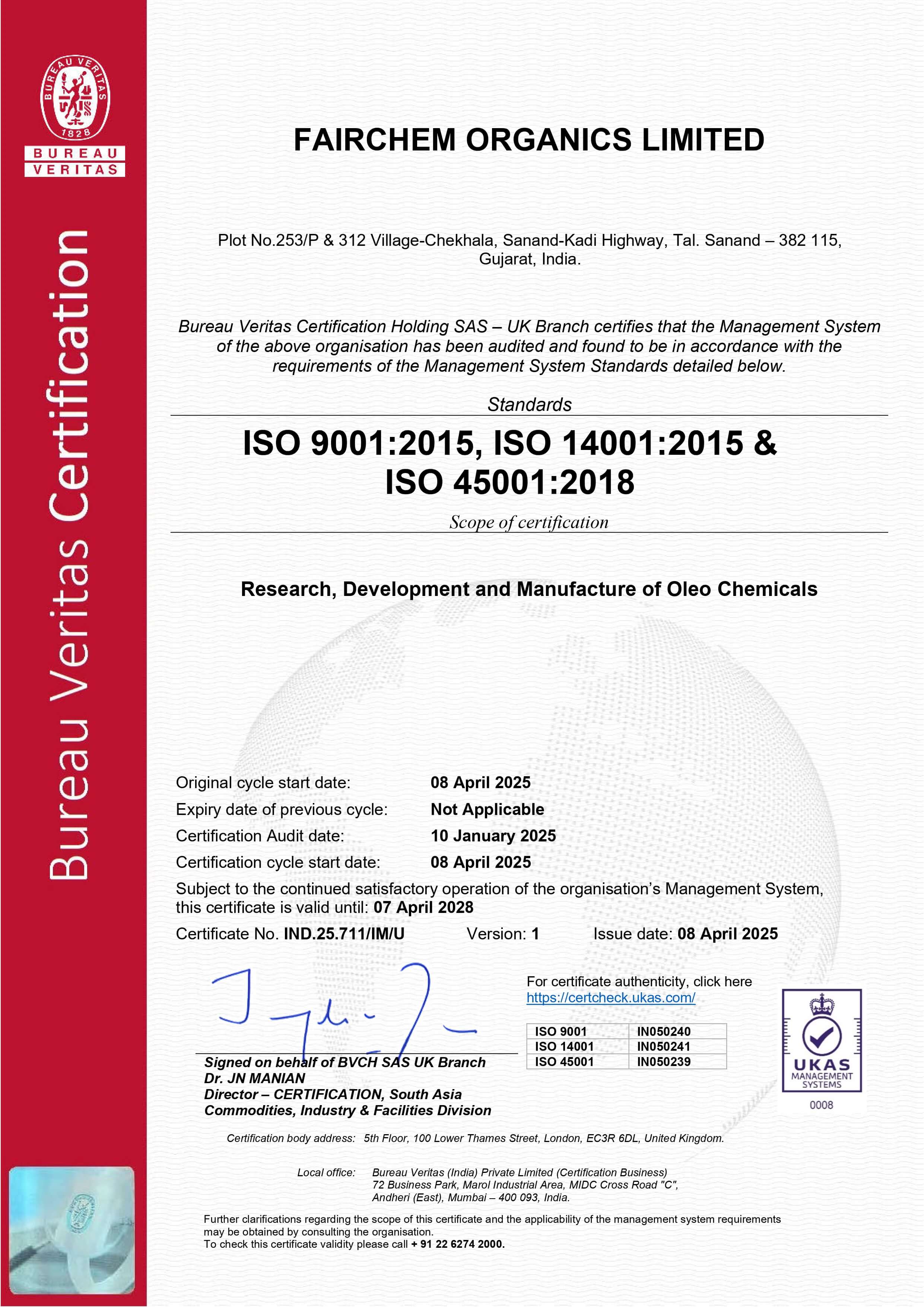
All products are manufactured to meet domestic and global quality standards and the company holds certifications including REACH Compliance, HALAL, Kosher, DUNS, and Bureau Veritas Certification. These credentials make Fairchem a qualified oleochemical supplier for regulated personal care and cosmetic industries both in India and internationally across Asia, Europe, and the Americas.
Evaluating Quality Oleochemical Ingredients for Your Formulations?
Whether you are developing a new personal care product line, scaling up manufacturing, or reviewing your current raw material supply chain, working with a certified and experienced oleochemical manufacturer ensures that your formulation quality stays consistent from batch to batch.
Fairchem Organics Limited is ready to support your requirements with high-quality cosmetic-grade oleochemical ingredients, consistent supply, and the technical expertise your formulation team needs.
For sales enquiries: comm@fairchem.in
Call us: +91 2717-687900 / 687901 | +91 90163 24095
Contact us today for product specifications, cosmetic-grade certifications, samples, and pricing customised to your application.
Frequently Asked Questions
Q1: Which oleochemical ingredient is most commonly used in lipstick formulations?
Isostearic acid is widely used in lipstick and lip gloss for its smooth spreading, non-greasy skin feel, and excellent compatibility with waxes, pigments, and silicones. Stearic acid is also commonly used as a structural ingredient.
Q2: Are oleochemical ingredients in cosmetics safe for sensitive skin?
Yes, generally. Oleochemical fatty acids are structurally similar to natural skin lipids, which makes them among the most skin-compatible cosmetic ingredients available. Specific suitability depends on the product formulation and individual skin type.
Q3: What certifications should I look for when sourcing oleochemical ingredients for cosmetics?
For cosmetic applications, look for REACH compliance (for Europe), HALAL and Kosher certifications for relevant markets, and detailed certificates of analysis showing acid value, iodine value, and Gardner colour grade for each batch.
Q4: Can Indian oleochemical manufacturers supply cosmetic-grade fatty acids for export?
Yes. Several established fatty acid manufacturers in India supply cosmetic-grade oleochemicals to markets in Europe, the Middle East, and Southeast Asia with appropriate certifications and documentation.